
Why Peter Beinart Doesn't Care About Israelis
How our conversation revealed a progressive imperialism that puts politics above people

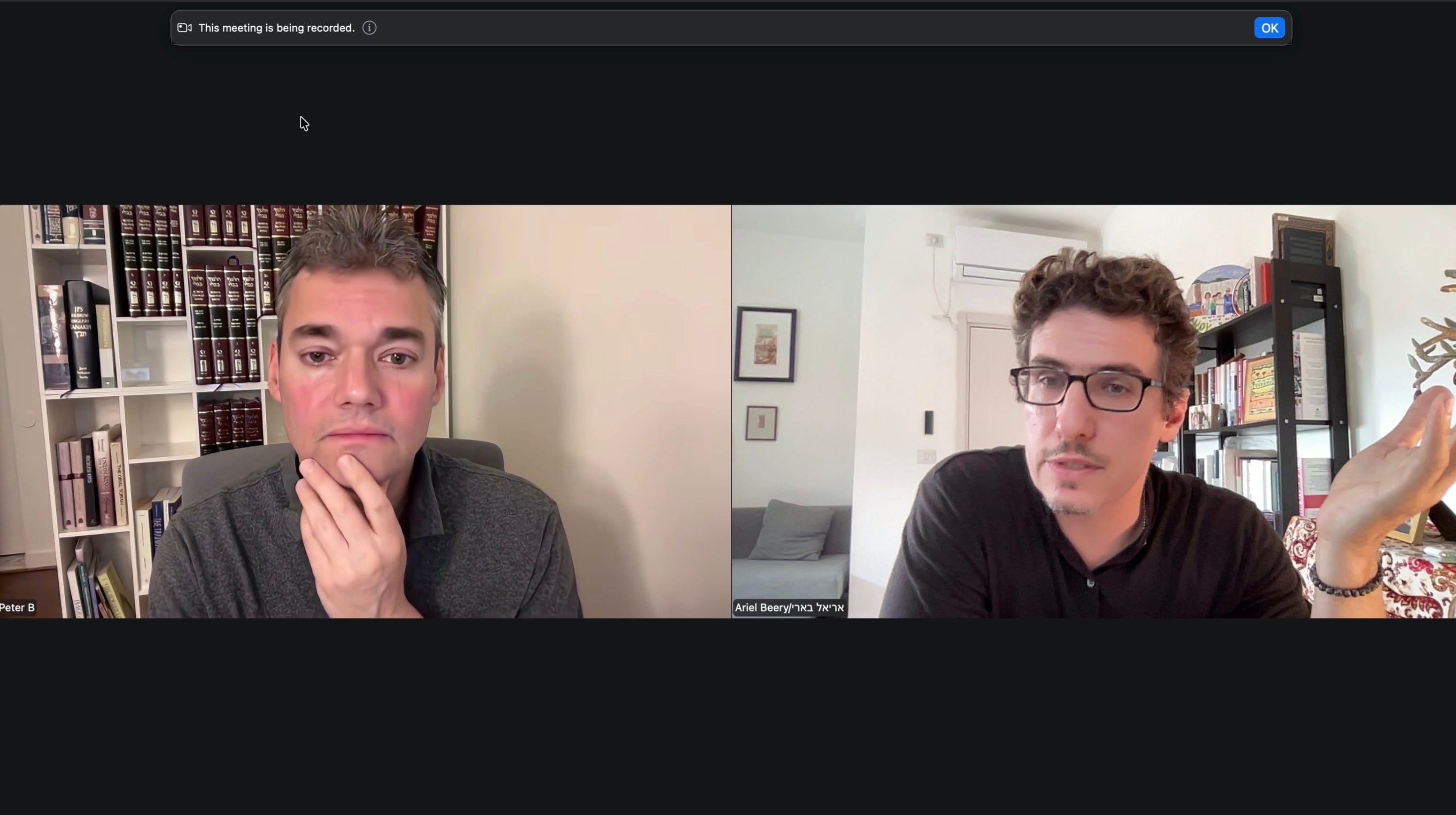
(First published on the Times of Israel)
When Peter Beinart reached out to interview me about my new book, Being Israeli After the Destruction of Gaza, I was curious what he would ask. I wrote it, after all, to respond to what I believe is the main failure of his Being Jewish After the Destruction of Gaza: his omission of the Israeli Jewish experience. I just couldn’t understand how one could write a book about being Jewish without taking into account the experience of Jews in the thick of it all. It felt like a moral failure that had to be corrected. Yet it wasn’t until Beinart interviewed me that I understood why he did it.
(The full interview can be viewed here; more information on my book, here.)
In a sentence, what I learned from the interview is that Beinart just doesn’t care about Israeli Jews. Whether they live or die, survive or thrive, is not really discussed in his book. Our experiences leading up to Oct 7th and those after are besides the point. They get in the way of his narrative, so must be ignored.
(He also, by the way, does not grapple with the identities and desires of non-Jews living in the Land – a group he flattens under the term ‘Palestinian’ despite their own various self-definitions which often reject being labeled as he does.)
No, Beinart does not want to complicate his narrative of the conflict because it serves him well to frame it as a Manichean battle between good and evil. Black and white chess pieces on a board. Doing so makes it easier for him, I can only assume, to confirm his place on the side of the ‘good’ and thereby maintain the grace of his American progressive peers.
I understood this because Beinart did not ask me one question about the Israeli experience that my book is devoted to. No question about the individuals whose stories make up the eleven chapters exploring the liberal, democratic Jewish experience in Israel. No moment of pause or reflection on how Meredith Mishkin-Rothbart returned to co-running her peace building organization weeks after the brutal invasion of October 7th, despite thinking she could no longer be a peace maker. No discussion of the complexity of Israeli identity as touchingly defined by Yau Levy. No desire to understand how Aliza Inbal’s belief in a Canadian bi-national future for Israel can be squared with her Zionism. No inquiry into how Bernard Avishai envisions the Hebrew Republic’s future, nor David Green’s understanding of how the current government capitalizes on victimhood to justify violence, nor questions about Noa Keinan’s belief in grassroots activism as the only thing we can do to break the alienation of the current moment.
To Beinart, Israelis don’t matter. Their beings are not of concern, their reckonings are rejected, their politics and perceptions are ignored in favor of Beinart’s analysis from his perch on the Upper West Side of Manhattan.
This incredible omission taught me two things: first, that Beinart does not believe in liberal democracy. Because a belief in liberal democracy – the belief that all human beings are created equal and therefore should have a voice in their political reality – would require him to engage with the very people who would need to agree to the political reality he would like created in the region. While he presents that all he wants is the creation of a non-Jewish “state of all its citizens” – one he assures us will treat each person equally before the law – he does not grapple with what those citizens actually want. As if such a state would last without the constant agreement of its citizens and avoid civil war if they opposed such an imposition. As if those same citizens do not already have desires of their own, political allegiances they’re ready to fight and kill and die to maintain.
Second, that he does not expect whatever state he wants the world to impose to last. Were he to believe in the egalitarian state he advocates for in place of the State of Israel, he would need to contend with the fact that the Jewish desire for self-determination is based on thousands of years of living as second-class citizens in all the countries of their dispersal. Jewish citizens – especially the more than majority whose roots are in Muslim lands – will fight to ensure that dhimmitude does not happen again. This is relevant because of the counter-desire of the Islamists leading the Palestinian movement who are motivated by more than a thousand years of Arab imperialism to impose their will on the residents of the Land. And all that is without bringing up Christian interests in the Holy Land, which few seem to remember when they hear ‘anti-War’ messages from the Pope.
Therein is the contradiction in Beinart’s advocacy: he claims to want to create a liberal democracy in the region while disregarding the fundamental actors that make liberal democracy possible: the people. Beinart is itching to take up the role of the benevolent dictator, willing to impose his views on people an ocean away, because he believes the world will be better for it. He may call himself a progressive, but we have an older word for that urge: imperialism.
It saddens me to learn this about Beinart, but I still have hope for the 14% of American Jews between 18-34 who now declare themselves anti-Zionists. I hope their democratic values will keep them from concluding, as Beinart does, that America should impose its political vision on Israel’s citizens. I hope their liberalism will bring them to engage with the Israelis who will determine the future of Israel, either by voting to make it so, or by reacting to imperialist pressure. And I hope they avoid Beinart’s moral failure and come to recognize that the experience of being Israeli after the destruction of Gaza is far more complex, challenging, and full of hope. Which is why I wrote my book, and why I hope Beinart’s readers will find the time to read it.

My new book, Being Israeli, is now available in paperback and hardcover. Copies can be ordered for most countries from Amazon, here, or in Israel from BookPod.
eBooks are also available where ever eBooks are sold — links to purchase can be found here:
Looking for a Way to Have More Honest Conversations About Israel in your Community?
Since October 7 and the war in Gaza, many Jews have found themselves wrestling with grief, responsibility, criticism, connection, and hope all at once. Yet many communities struggle to create space for those conversations without people feeling pushed into opposing camps.
Over the past year, I’ve been speaking with Israeli activists, journalists, academics, peacebuilders, and civil society leaders about what it means to remain committed to Israel while also grappling honestly with its failures, its traumas, and its future. Those conversations became my book, Being Israeli After the Destruction of Gaza.
I’m now bringing those conversations into Jewish communities through talks, moderated dialogues, and facilitated community discussions designed to help people engage difficult questions with greater nuance, empathy, and understanding. Participants consistently tell me they leave with a deeper appreciation not only of Israeli society, but of one another.
Programs can be tailored for synagogues, JCCs, federations, campuses, leadership groups, salons, and community-wide events.
I’ll be in the United States in July 2026 for a limited number of speaking engagements and community conversations. If you think your community would benefit from a conversation like this, I’d be glad to explore it with you:
I listened to the interview, and recommend everyone who reads you article to the same. Here's my take:
There is no doubt that Peter Beinart doesn't care about Israelis –based on his body of work and definitely reinforced by this conversation. He not only is unwilling to focus on the lives and needs of Israelis, he doesn’t seem to register at all the threats of annihilation that Israelis have been living under for decades. Israeli defense doesn't even seem to occupy one neuron in his brain.
And I would also say that he has a strange, caricatured perspective on Palestinians and other Arabs. To him they are a homogenous, indistinguishable group of people, without agency, responsibility or accountability.
Since his entire worldview is ahistorical, never digging beyond the superficial level of issues, this leaves him with some pretty hollow reasoning. He is unwilling to recognize/distinguish the situation of Arab/Palestinian Israelis from those in the West Bank. Not only is the situation different between those two populations, one has shown itself willing to live in peace with Israel and the other has demonstrated, sadly far too many times, that they are not willing to live in peace next to Israel, turning down multiple offers of peace and statehood, and often resorting to terrorism as a way to advance their cause. Beinart ignores this – He, you and I would all like to see the military occupation end, but he (like so many people) see this just as an issue of Israeli discretion, discounting the obvious dangers of leaving in a way that leads to Gaza x 50.
Same with the right of return – yes, it is painful, but he ignores the real threats to Israelis if that were to happen, and this is where his ahistorical nature really comes into play: Beyond acknowledging the way every other refugee crisis since WWII has been solved, he completely ignores that this problem of Palestinian displacement would not have happened if they had accepted the 1947 UN Partition Plan and if five Arab armies had not attacked Israel as soon as it was born, with the goal of destroying the country and killing all of its inhabitants. Aggressive, discretionary war has its costs. I feel tons of empathy for those Arabs who displaced, as I do for all other populations who were displaced in the middle of the last century. But there is a lot of historical context, and real-life threats, that Beinart ignores.
Israeli has much agency, and much to answer for, in this situation. But this pattern of ignoring Palestinian/Arab agency, responsibility and accountability, which leads to all blame falling to Israel, is a non-starter for any progress. Does Beinart even know about the multiple peace/statehood offers the Palestinians (or the Arabs on their behalf) have turned down? We’ve seen how this lopsided approach has empowered Israel’s jihadist enemies since October 7, making peace harder to achieve. Which is why this refusal to acknowledge Palestinians agency is bad for them ... it motivates them to continue avoiding peace, which hardens Israeli fear and resolve, leading to a negative, self-reinforcing cycle.
One other inaccurate point from Beinart: He talked about how unfair it is that the Jewish National Fund administers so much of the funding that goes into managing certain land and infrastructure projects, because that supposedly benefits one ethnic group, the Jews. JNF’s mission is focused on the peripheries of Israel, focused on the north and the south of the country, and much of their work benefits Arab communities. Many of the areas where they work and create positive impact in the north are majority Arab. Just one more example of Peter Beinart’s false sense of certainty, his dangerous naivete, and why nobody should listen to him.
The problem with post-Zionist fantasies such as Beinart’s is not only that they ask Israeli Jews to self-dissolve in a region where armed conflict is inevitable.
More deeply: once that conflict begins, where exactly is the political will to save Jews supposed to come from?
From international actors who do not believe Israel has a right to exist? From movements that treat Israel itself as the original sin? From institutions that see Israeli Jews not as a legitimate people, but as a colonial problem to be eliminated?
They are asking Jews to give up the only protection they actually have, and then depend on the very same world that has already decided their protection is illegitimate.
It is suicide.